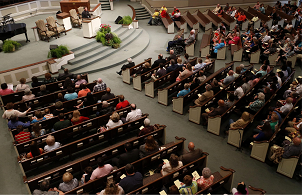
Attractional evangelism in its many forms has been used from the time of George Whitfield through to Billy Graham and has been the catalyst to bring many into the kingdom of God. Today it is still used in many church services where non-believers are invited to put their faith in Jesus. Yet alongside all of this good, there are some very real dangers to the over-reliance on attractional forms of evangelism.
In this method the church attempts to evangelise the community by attracting people to its buildings, services, events, or programs. The idea behind this approach is that you offer people what they want or enjoy and they “come to your church.” It is assumed that as they attend the church’s programs they will find Christ and become disciples.
There are a number of major weaknesses in this approach:
1. It does not make disciples; it attracts consumers.
The attractional method typically appeals to the needs or desires of those it is targeting and must deliver those needs and desires at a “price” the target group is willing to pay. Is this more than religious consumerism? At some point we must call people to a deeper level of commitment and sacrifice in their walk with Jesus. When that call comes later rather than earlier, the person has already “bought into” a form of Christianity which has allowed him or her to be a Christian without being a disciple. Too often this results in what Dallas Willard calls the “cost of non-discipleship”.
2. It is expensive and resource intensive.
Bringing non-believers into a church using the attractional method often requires a steady menu of consumer-oriented approaches, programs, and events involving facilities, resources, staff, and media. The focus too easily becomes the development of these attractional features rather than intentionally and organically discipling people.
3. It is not easily reproducible.
Those who have sufficient resources to support the attractional method can do it well. Those who do not have sufficient resources will struggle to reproduce the attractional model. Because it is dependent on resources for its success, this method is inherently artificial rather than organic. At best it can lead to addition growth but never multiplication growth.
4. What you win them by is what you win them to.
What is the effect on the church when it attracts people by giving them what they want or need? The church becomes the object of its own ministry. The community becomes a means by which the church grows, instead of the church being a means by which the community is reached.
How will an attractional approach affect the call of Christ on those who respond to it? Having responded to our offers and provision of what they want or need, they must move to a point where they obey Christ’s command to deny themselves, take up their cross, and follow Him!
It also unintentionally puts churches in competition with one another. The reality is that those who respond to the attractional method will typically be those who are open to attending a church. Statistics indicate that in the future that will be a smaller and smaller percentage of the general population and Churches will have to compete for this group.
5. It creates a weak “point of connection”.
When you rely on the attractional approach you will connect people to your church by appealing to what they like, want, or feel they need. This creates a very weak point of connection to the church. It is a very weak connection because:
- It requires little commitment from people. They are connected to the church by the things which attracted them to the church rather than by a commitment to Christ.
- It requires little commitment from your members, especially in the area of making disciples. They are encouraged to invite someone to church rather than sharing one’s faith and walking with people.
- It requires you (the church pastor/leader) to focus your attention, time, and resources on providing what people want and enjoy rather than leading them into what God requires.
In the attractional approach we measure the growth of a church in terms of the success of our programs (i.e. the youth ministry is successful if it attracts more youth). If we are using our worship services to attract new people, then our worship services will be (rightfully) measured by how many people they attract.
However, if we are using our worship services to worship God, one must seriously question how prominent a role increasing numbers should play in measuring the success of those services and in determining what we do in them. Perhaps there are other more important assessments we would want to focus on such as the spiritual qualities, transformation, God’s manifest presence, obedience, Biblical teaching, etc.
If we measure a growing church in terms of attendance, then we will pursue it in terms of attendance. If we measure it in terms of spiritual transformation and community impact, then we will pursue it in terms of spiritual transformation and community impact. Of what value is a full service when the local schools and neighbourhoods are left unchanged?
While increasing numbers can indicate an increase in spiritual growth, it is questionable whether or not it is enough of an indication to warrant the current level of attention it receives in modern institutional church strategies.
In the end, we must question whether or not the numerical growth of services, programs, or meetings should be the consuming focus of visionary church leadership and whether or not increasing numbers “in church” means increasing numbers in the Church.